The women's side of the workroom was small for a long time and is now a genuinely growing part of the business. It is also the thing people are most surprised to learn we do, which says more about how tailoring markets itself than about the craft.
What is actually different
Less than the industry implies, and the differences that exist are technical rather than categorical.
- More shaping through the body, which means more seams doing work — and more places where a quarter-inch shows
- The bust, which is a fitting problem with several correct solutions rather than one, and which a block cannot resolve well because it has to assume a shape
- Sleeve and armhole proportions differ, and the armhole is if anything even less forgiving of being cut low
- A wider legitimate range of silhouette. Menswear has converged; women's tailoring has not, and that is an advantage rather than a complication
What is not different is everything that matters most. The shoulder still decides whether the garment looks right. Balance still has to be read off how somebody actually stands. Inlay still determines whether the garment has a future. The pattern is still drafted from paper for one body.
Where it is going
Mostly business suiting and full suit design — the wardrobe of someone whose presence is part of the job. It overlaps heavily with image consulting for that reason: the questions are the same ones, about rooms and audiences and what a garment is being asked to do.
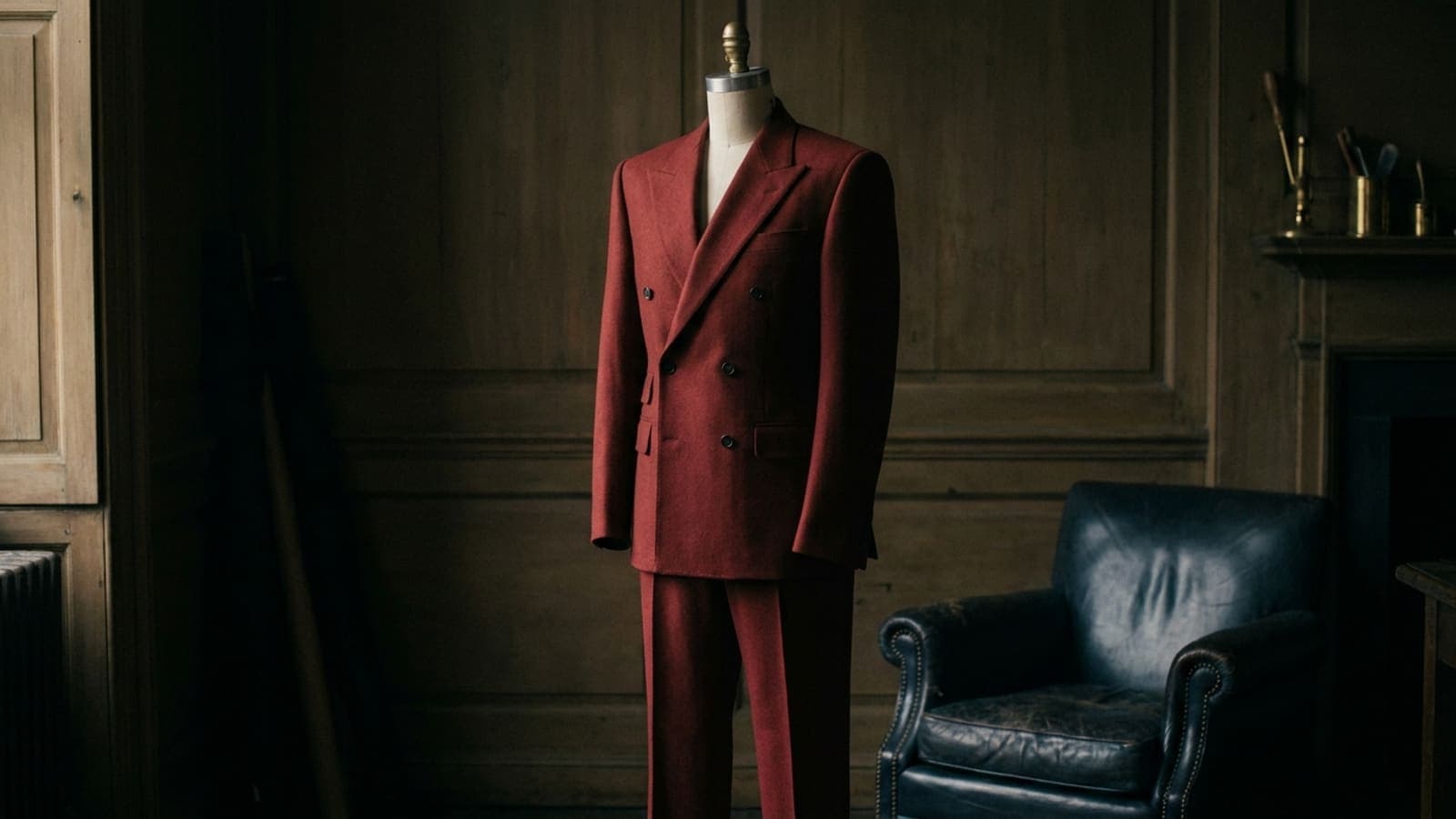
The deep red double-breasted suit in the photograph is a fair example of the point. It is not a risk, it is a decision, and it is more elegant than a compromise would have been. Saturated colour worn as a whole outfit reads as deliberate; the same colour used as an accent reads as an accident.
What we do not take
Simple alterations — casual dress strap repairs, hems on old jeans, and similar. Those are better handled by a local dry cleaner or an alterations shop, and I would rather point you there than have the work sit in a queue.
The reason is not the garment. It is that a full suit redesign cannot be held up behind a twenty-dollar jumpsuit, and taking both means doing one of them badly. The same logic applies to bridesmaids' dresses, which we no longer take on. Bridal gowns, yes.
Stated plainly because the alternative is somebody arriving hopeful and being turned away at the counter, which is a worse experience than reading it here.
Starting
The same way as anything else: a commission appointment, forty-five minutes, a $75 bespoke deposit, and mostly conversation. Where the question is less about one garment and more about the whole wardrobe, a full audit is usually the better place to begin.
Why the market is thinner than it should be
Not demand. Women arrive here having tried and failed to find somebody who takes the work seriously, and the failure is usually one of two kinds: a menswear house that treats a women's commission as a men's pattern with adjustments, or a dressmaker who is excellent with soft construction and has never built a canvassed jacket.
Both are real skills. Tailoring in the sense meant here is a third thing — structured construction, canvas, a drafted pattern — and the number of places doing it for women is genuinely small. That is a gap rather than a preference, and it is why this side of the workroom has grown without much effort on our part.
The fit conversation that goes differently
Sizing. Almost every woman who comes in has a long history of being told a number, and of that number meaning something different in every shop. A drafted pattern removes the question entirely — there is no size, there is a pattern — and the relief in the room when that lands is noticeable.
The other is what tailoring is allowed to be. There is an assumption that a woman's suit has to be either severe or apologetic. It does not. The silhouette range in women's tailoring is genuinely wider than in menswear, which has converged, and that is an advantage available to anybody willing to make a decision rather than a compromise.