When someone brings me a jacket and asks whether it can be made to fit, I look at the shoulder first and everything else second. Not because the rest does not matter, but because the rest is negotiable and the shoulder mostly is not. A waist can be taken in. A sleeve can be shortened. A shoulder that is wrong was wrong before anybody bought it, and correcting it means taking the jacket substantially apart.
It is also the thing people notice without knowing they have noticed. Ask someone why a suit looks expensive and they will say the fabric. It is almost never the fabric.
What the seam is actually doing
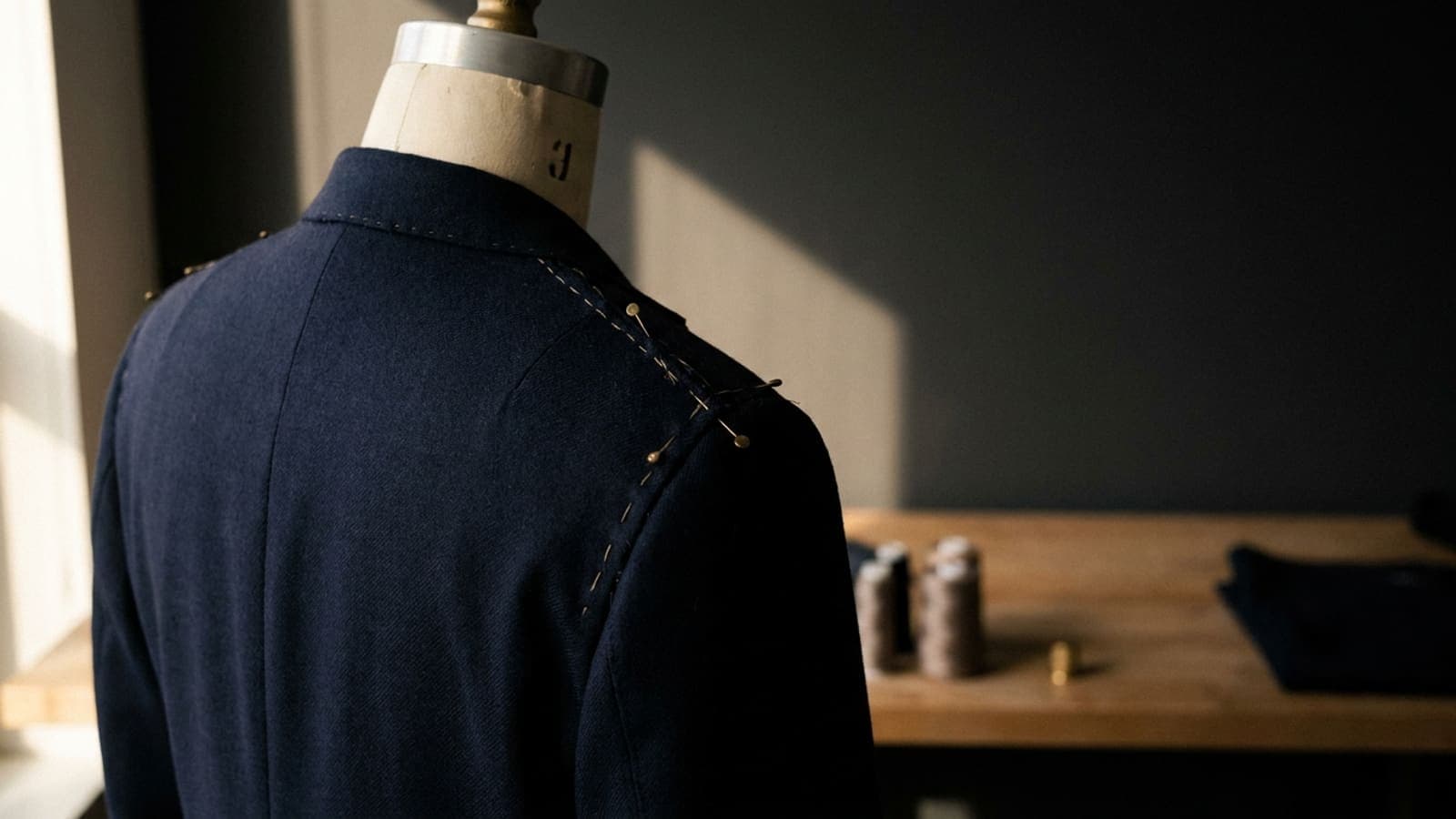
The join between the sleeve and the body is the hardest seam in tailoring, and the reason is geometric. The top of the sleeve — the sleeve head — has more fabric in it than the hole it has to fit into. That surplus is deliberate; it is what allows your arm to move forward without dragging the whole front of the jacket with it. But it has to be got in somehow, and where it goes determines the shape of the finished shoulder.
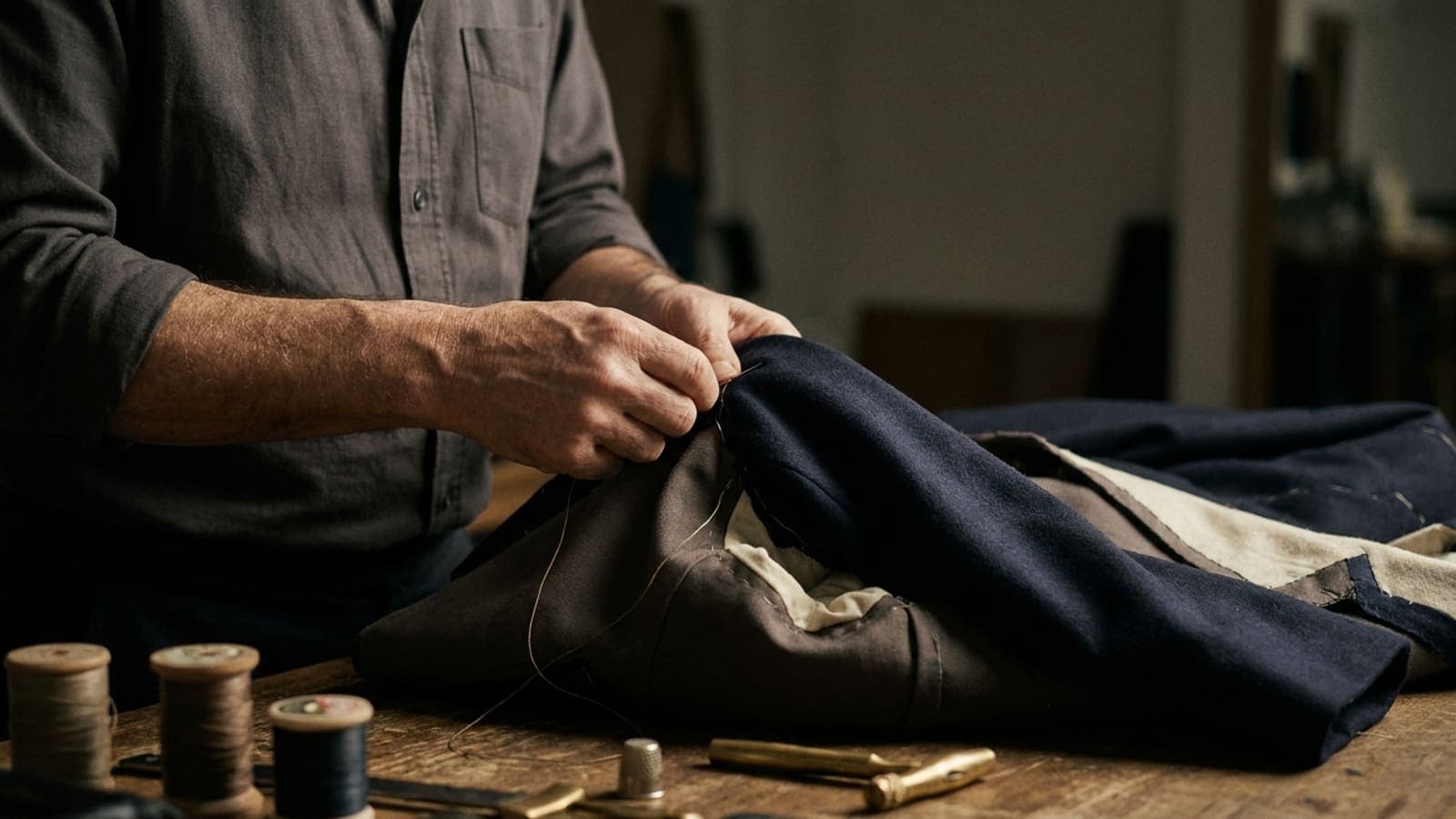
Done by machine, the ease goes in fast and evenly distributed. It works, and it looks like what it is: even. Done by hand, the ease can be concentrated where it is wanted — over the top of the shoulder where the arm rotates — and withheld at the front and back where extra fabric would only ripple. That is the difference between a shoulder that looks alive and one that looks pressed flat.
Everybody is asymmetrical
In over ten thousand hours of fitting I have never measured a pair of shoulders that matched. Most people carry one lower than the other, usually the dominant side, and often by more than they would guess — a quarter of an inch is common and half an inch is not rare.
This is why a garment can measure correctly and still look wrong. A jacket cut symmetrically onto an asymmetrical body has to resolve the difference somewhere, and it resolves it by pulling: a diagonal crease running from the low shoulder toward the opposite hip, or a collar that stands away from the neck on one side. People look at that and conclude the jacket is too big. It is not too big. It is level, and they are not.
A bespoke pattern simply accounts for it. The two sides are drafted differently, because the person is. That is the whole argument for a pattern drafted from paper rather than a block adjusted at the edges — a block cannot know which of your shoulders is lower, and no amount of adjusting the seams afterwards fully recovers it.
Judging one in ten seconds
Put the jacket on, stand naturally, and look at four things:
- Does the shoulder seam end where your shoulder ends? Past it and the jacket will collapse into a divot below the seam; short of it and the sleeve head will bunch
- Is there a dent just below the seam, at the top of the sleeve? That is the sleeve head being forced into a hole cut too small for it, and it does not settle with wear
- Do diagonal creases run from one shoulder across the back? That is the jacket resolving an asymmetry it was not cut for
- Raise both arms halfway. Does the whole jacket lift with them, or does the body stay roughly where it was? A good armhole is higher and smaller than most people expect, and it is what lets the body stay put
That last one surprises people most. A large, low armhole feels more comfortable in the shop and is worse in every other respect, because it ties the jacket body to your arm. High armholes are one of the things that separate tailoring from clothing, and they are also one of the things that makes a jacket feel like it disappears.
What can be done about a bad one
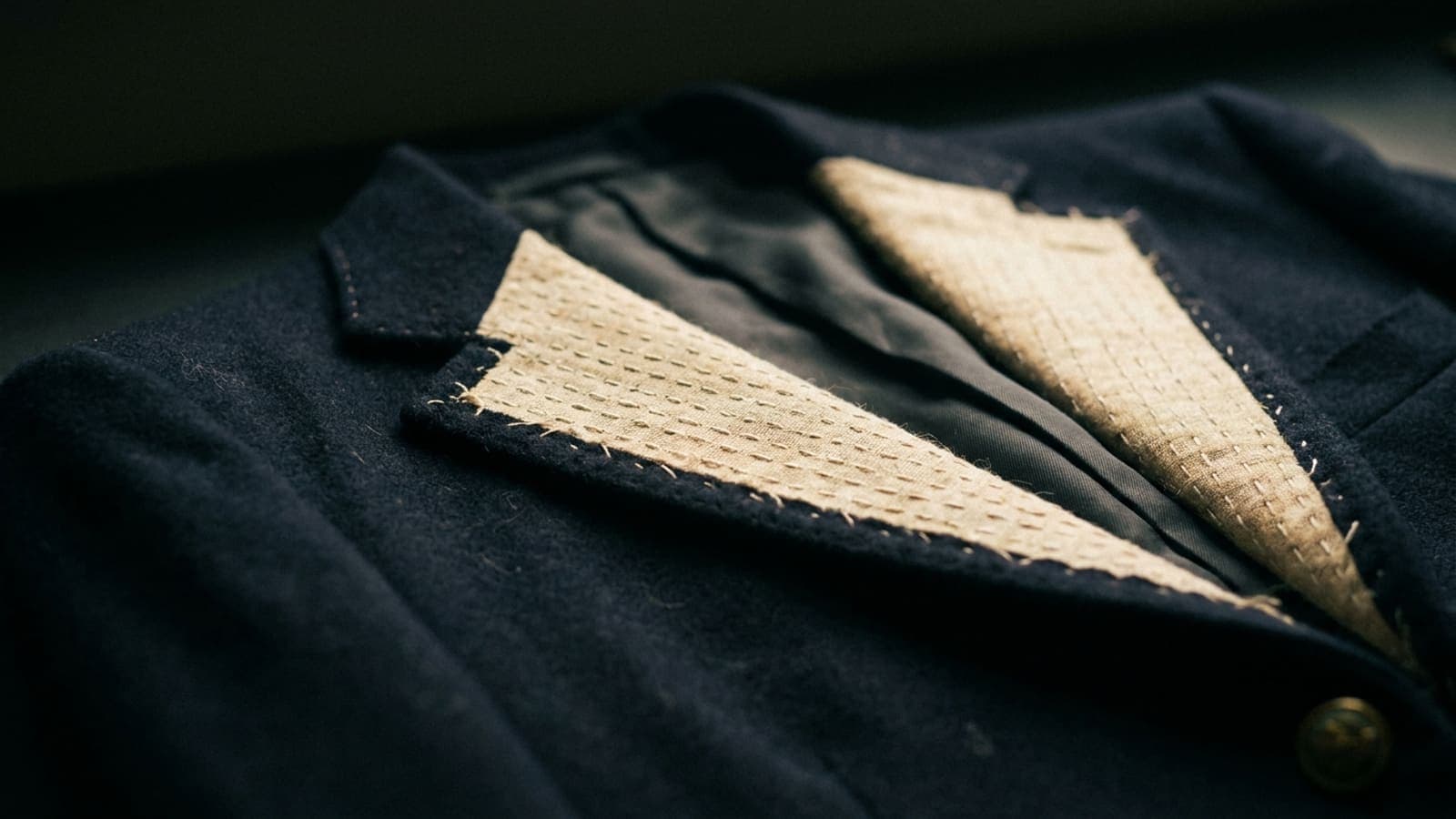
It can be corrected. The sleeve comes out and goes back in, and where the shoulder itself is at fault the padding and canvas underneath are reworked. It is real work — the most involved thing we do to a garment that we did not make.
Whether it is worth doing depends entirely on what is underneath. On a canvassed jacket from a good house there is something to work with, and the result can be genuinely transformative. On a fused jacket there is a glued layer rather than a floating one, and reshaping it is either impossible or so marginal that I will tell you not to bother.
That is the conversation I would rather have at the counter than after taking your money. If a garment is not worth the work, the useful answer is that it is not worth the work.
Why ready-to-wear cannot solve this
A manufacturer producing thousands of jackets has to choose a shoulder slope, and the one they choose is an average. That average is not wrong — it is right for the middle of the distribution and progressively less right the further out you sit. Anyone with square shoulders or notably sloping ones is buying a garment designed around somebody else, and no amount of size selection changes it, because size varies width and length rather than angle.
This is also why the same nominal size fits differently between houses. What varies is not the tape measurement but the block underneath — the assumptions about slope, about how far forward the arm sits, about how much room to leave across the blades. When somebody tells me they are a 42 in one label and a 40 in another, they are describing two different sets of assumptions rather than an inconsistency.
The padding question
People often assume the shoulder is padding, and that removing it produces a softer, more natural line. Sometimes it does. Frequently it produces a collapse, because the padding was holding up a sleeve head that was cut on the assumption of support.
A genuinely soft shoulder is not an ordinary shoulder with the padding taken out. It is cut differently from the start, with less ease in the sleeve head and a different relationship between the shoulder seam and the body. That is a pattern decision made before anything is cut, which is why it is straightforward in a commission and awkward as an alteration.