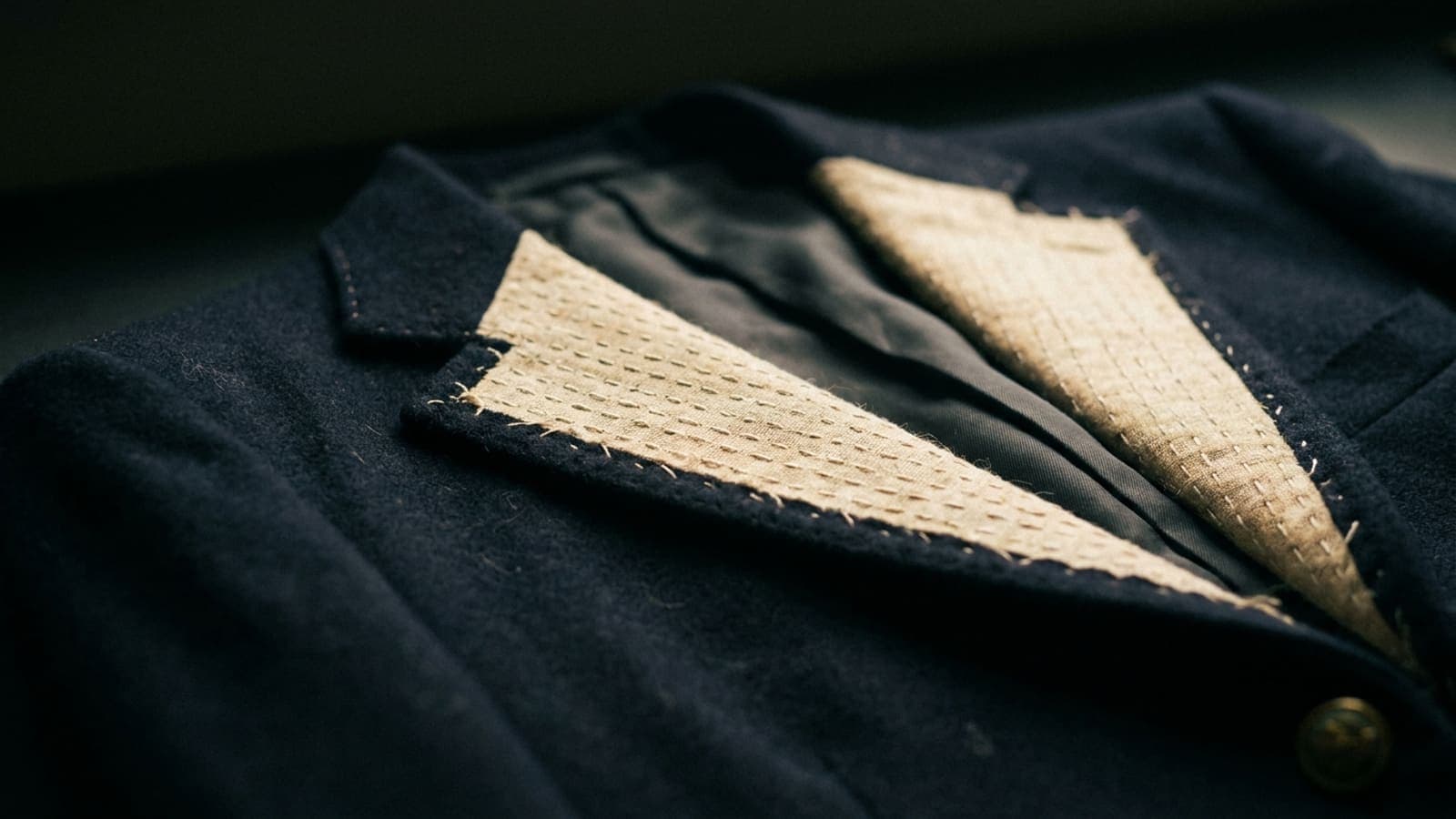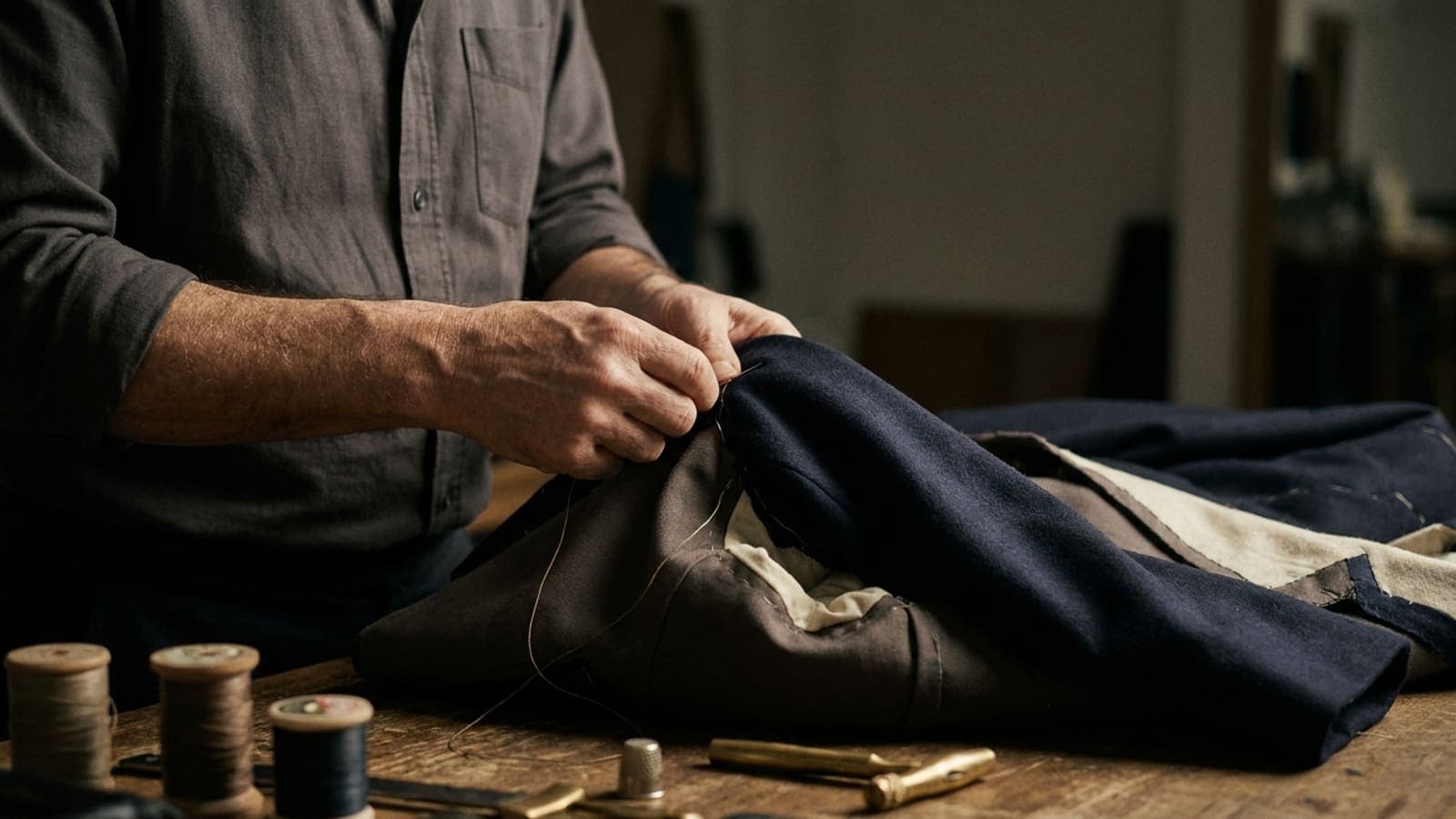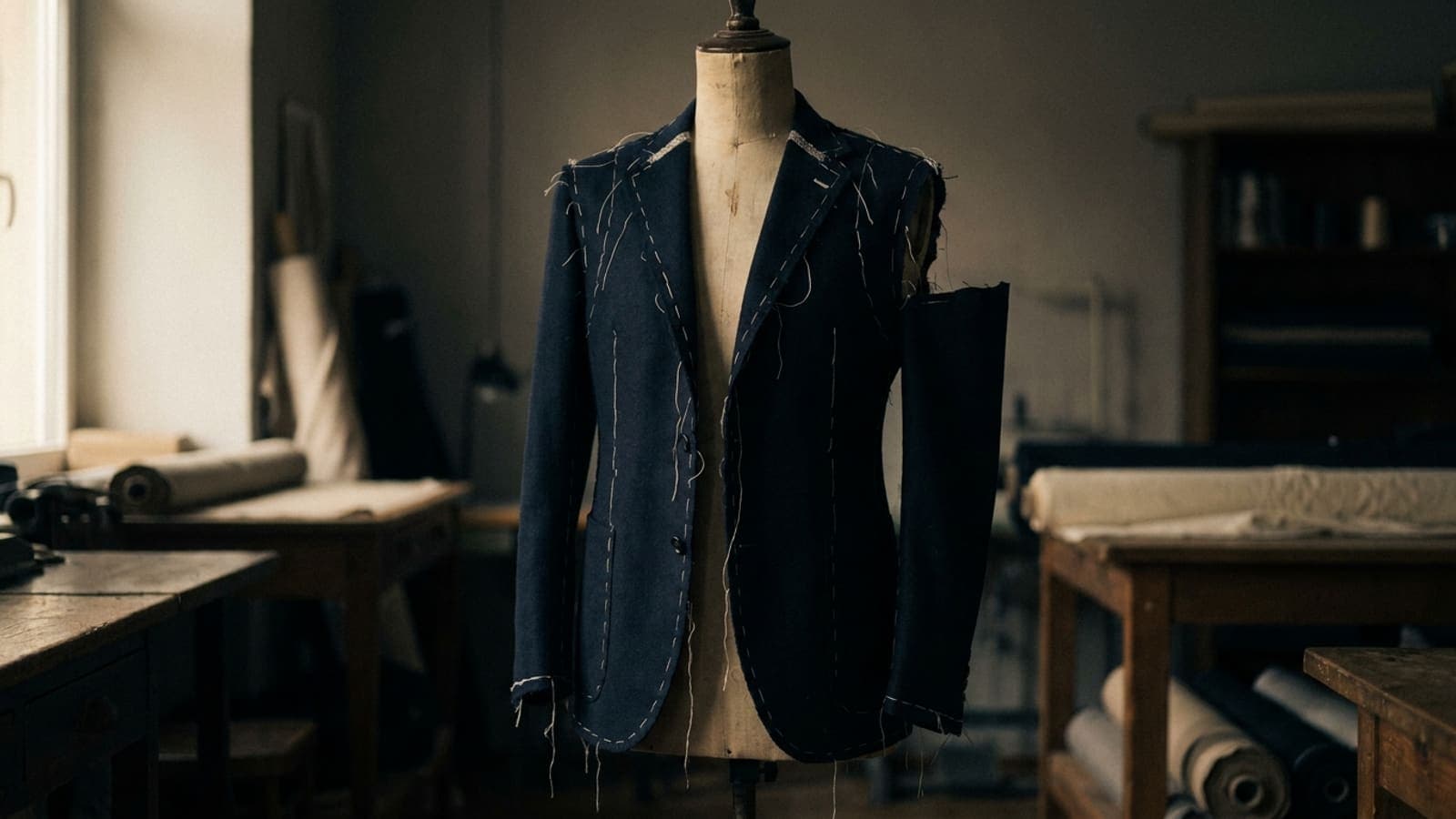
There is a moment in every first commission where the client's face changes. It is when they put on the basted fitting and see themselves in a garment that is white with tacking thread, unpressed, with one sleeve on and sometimes neither, and no lining at all. They have paid a deposit and waited weeks, and this is what they get.
I have learned to warn people. It looks worse than anything you would ever choose to wear. That is exactly why it works.
Nothing is committed
A basted fitting is a jacket assembled with long, loose stitches in contrasting thread instead of proper seams. Every one of those stitches is designed to be pulled out. The canvas is in, the pattern has been cut in your actual cloth, and the shape is there — but nothing has been finalised, so everything can still be moved.
Contrast that with a finished garment. Once a jacket is properly sewn, pressed and lined, the amount that can be changed drops enormously. The seams have been trimmed, the canvas has been shaped, the lining has been cut to fit the inside. Altering it is corrective work, and corrective work is always a compromise with decisions somebody else already made.
At the basted stage there are no decisions to compromise with. That is the whole point of the appointment, and it is why we do not skip it.
What we are actually looking for
Balance, first. Balance is the relationship between the front length and the back length of a jacket, and it is the thing most likely to be wrong on a body that does not stand the way a pattern assumes. A man who stands slightly upright needs more length in the back; one who stands forward needs more in the front. Get it wrong and the jacket will either ride up at the back or collar-gap at the neck, and neither is fixable later by any amount of taking in.
Then the shoulder, which is where the sleeve is either going to hang correctly or not for the life of the garment. Then drape through the chest — whether the cloth falls cleanly or pulls across. Then, much later and much less interestingly, the things people expect us to be measuring: sleeve length, jacket length, how much the trouser breaks.
Things I will do at a basted fitting that alarm people the first time:
- Cut the jacket open with scissors, down a seam, to let a section sit where it wants to
- Chalk directly onto your cloth
- Pin the back so tightly that you cannot lower your arms, then unpin it and do it again three-eighths of an inch looser
- Ask you to stand still and say nothing for an uncomfortably long time
That last one is not theatre. Half of fitting is looking, and looking properly takes longer than conversation allows for.
Why it comes third, not first
A commission runs through three fittings after the first appointment, and they are sequenced deliberately. A scrap fitting comes first: the paper pattern proved in inexpensive fabric, before your cloth is cut, so the expensive mistakes happen on material nobody paid for. The basted fitting is second, in your actual cloth, with everything still moveable. The forward fitting is last, and by then we are refining rather than solving.
People occasionally ask whether they can skip one. They can, in the sense that we could physically make a garment without it. What they would be buying is a jacket that had one fewer chance to be right, on a body that has never been fitted here before. The three fittings are not ceremony; they are the number of attempts it takes.
The thing worth understanding
Ready-to-wear inverts this. You see the garment at its most finished and most flattering — pressed, lined, on a hanger, in a shop lit to sell it — and then you find out over the following year what is actually wrong with it.
Bespoke shows you the garment at its ugliest and asks you to trust the process. The basted fitting is where a commission is won or lost, and a client who sits through it patiently gets a better jacket than one who is hurried through it. It is the least photogenic hour of the whole thing and by some distance the most valuable.
What clients get wrong at this appointment
Two things, both understandable. The first is being polite. Somebody has made you a half-garment and is now standing behind you with pins, and there is a strong social pull toward saying that it feels fine. If something pulls, or catches, or feels tight when you reach forward, this is the appointment where saying so costs nothing. At the forward fitting it costs a great deal more.
The second is trying to picture the finished garment. It is almost impossible, and attempting it makes people anxious about details that are not yet decided. The lapel will not roll properly until it is pressed. The fronts will not hang cleanly until the lining is in. What you are being asked to assess is where the garment sits on your body, not what it looks like — and those are genuinely different questions.
Why some houses skip it
Because it is expensive. A basted fitting means making the garment twice in a sense: assembling it, taking it apart, and reassembling it with the corrections. That is labour, and labour is the largest cost in anything hand-finished.
The commercial temptation is to fit once, at the end, and handle whatever is wrong as an alteration. That produces a garment that is adjusted rather than made — and the adjustments are constrained by decisions that have already been committed to. It is the difference between building something to a plan and correcting something that was built to a different one.