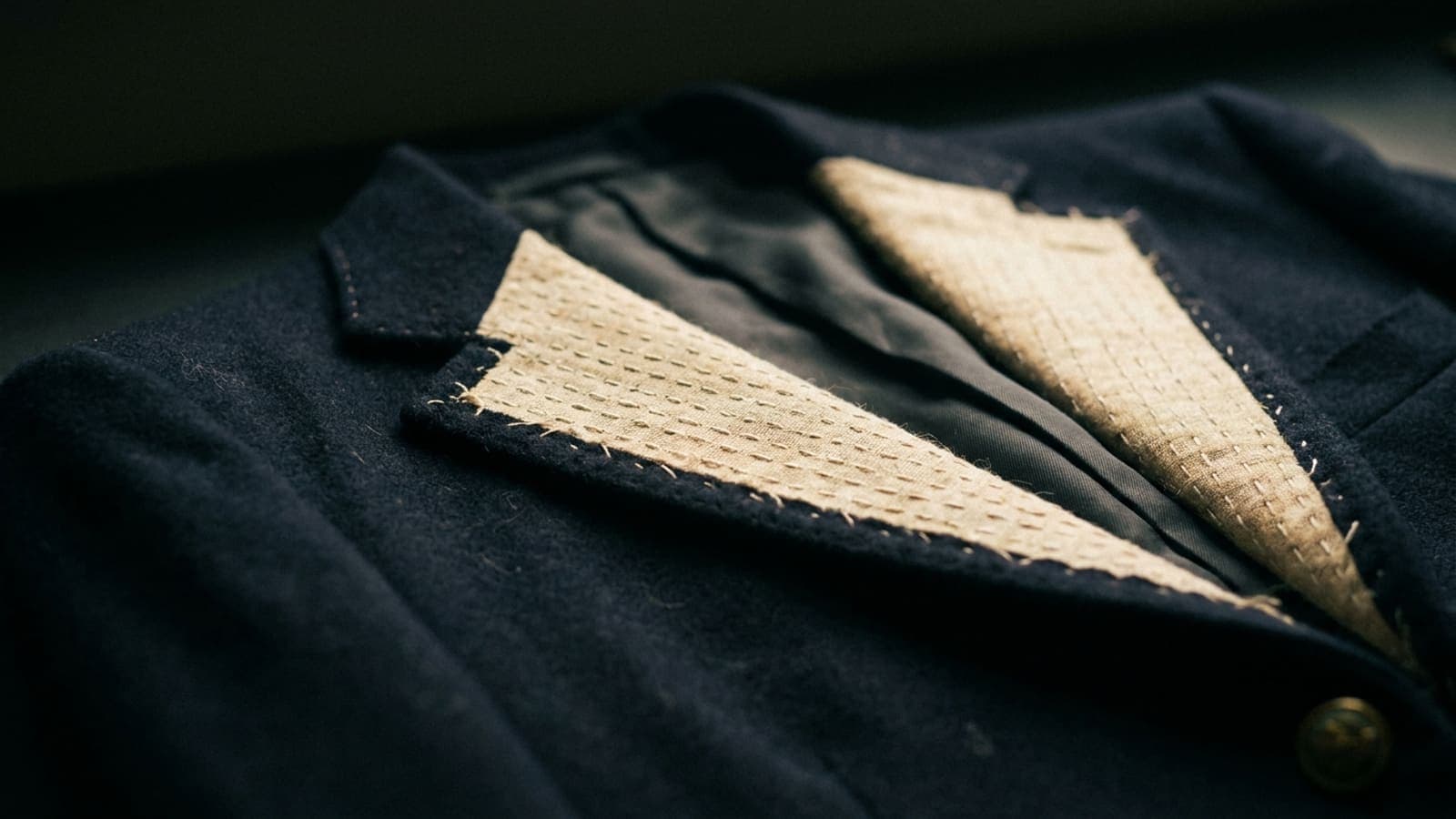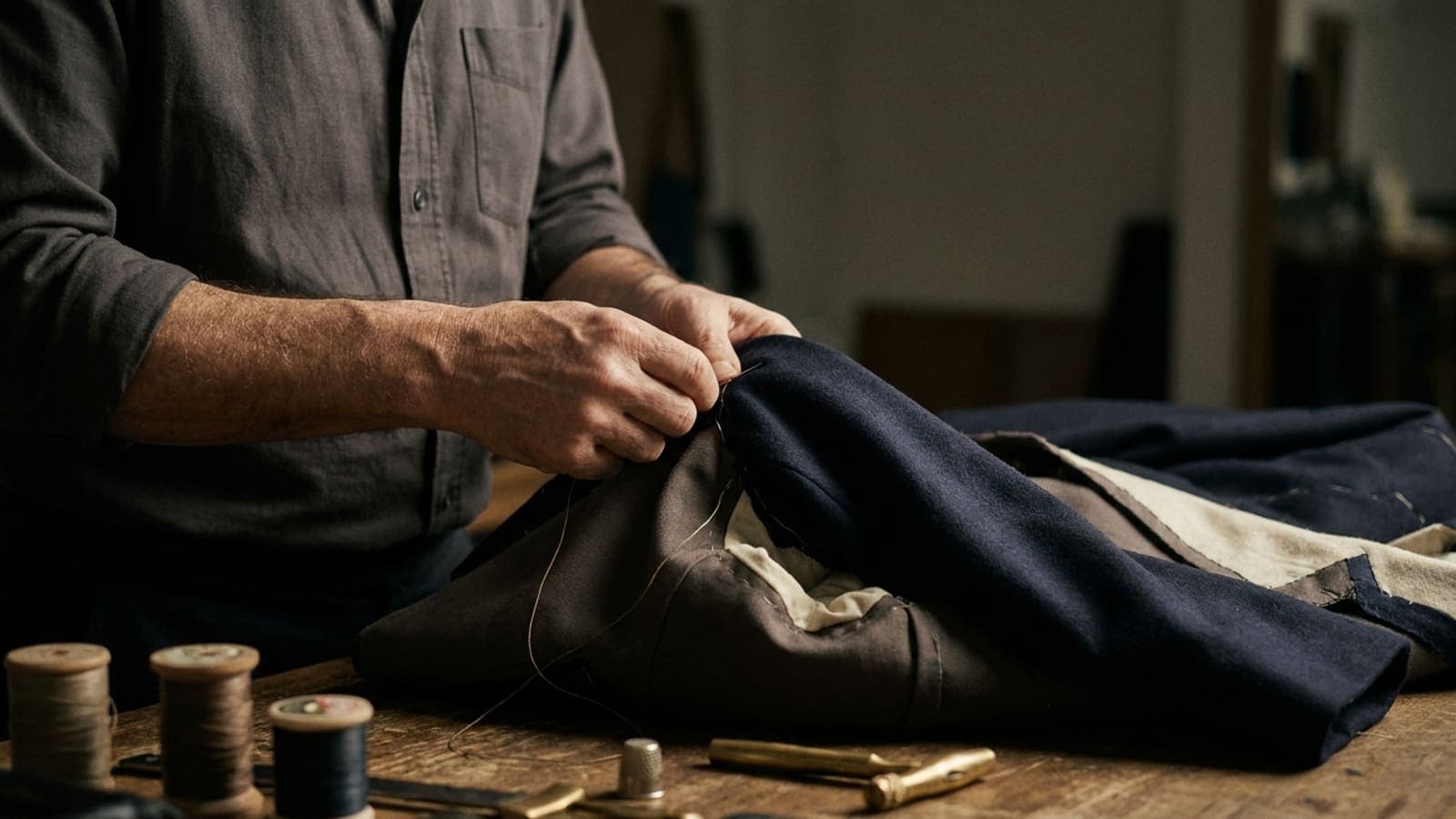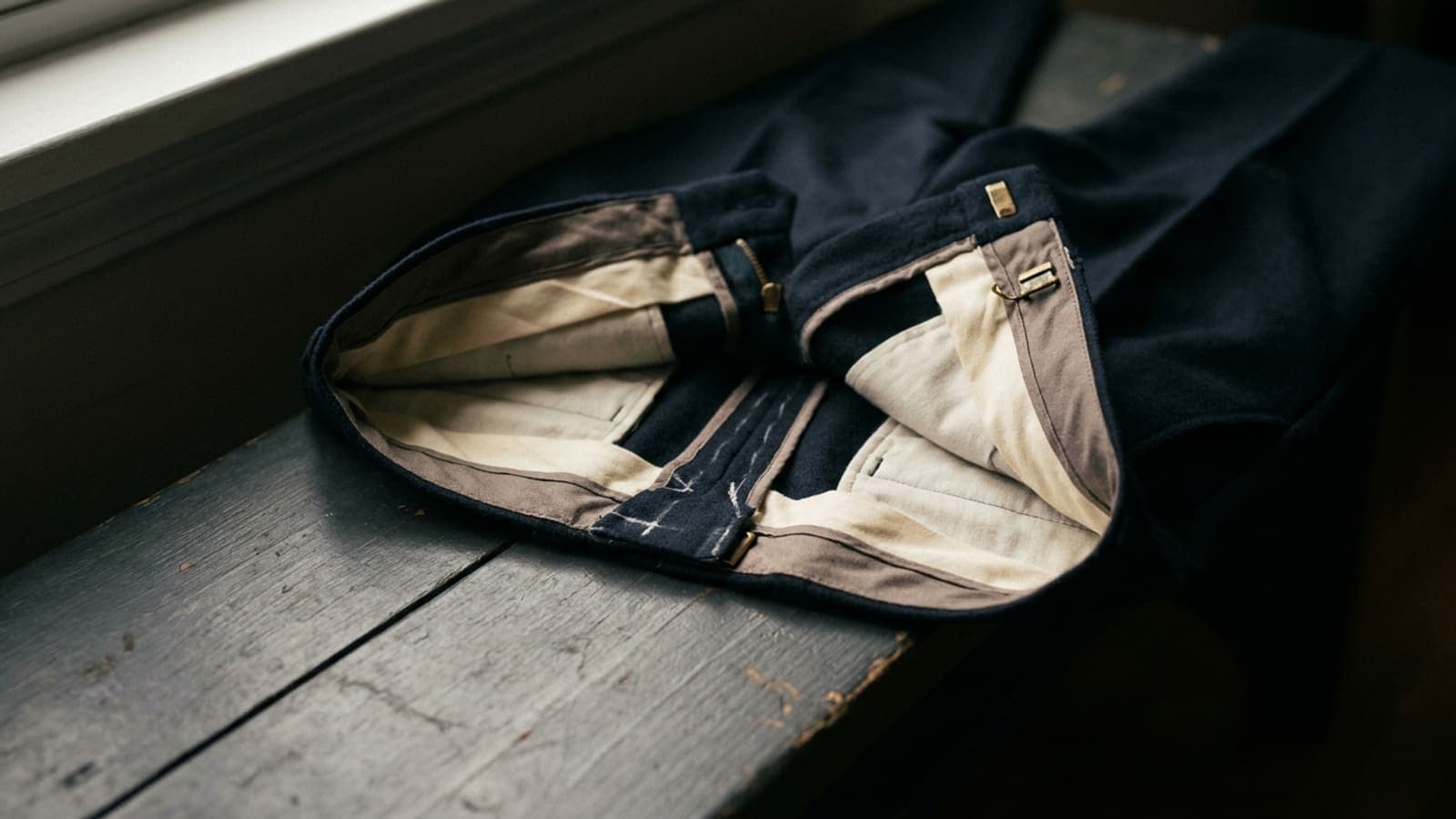
There is a decision made in the workroom, before a garment is ever finished, that the person buying it will never see and will not think about for about six years. Then one day they will bring the jacket back and ask whether it can be let out, and the answer will already have been settled.
The decision is how much cloth to leave in the seams. It is called inlay, and it is the single best predictor of how long a garment will stay wearable.
What it is
When two pieces of cloth are joined, some fabric sits beyond the stitch line on the inside. That surplus is the inlay. If it is generous, a tailor has something to work with later — the seam can be opened and re-sewn further out, and the garment gets bigger. If it has been trimmed close, there is nothing to give back.
Manufacturers trim it for good commercial reasons. Cloth costs money, and a pattern laid out to leave generous inlay yields fewer garments per roll. On a garment designed to be worn for two seasons that is a rational trade. On a garment you were told would last, it is not.
How to check, in about a minute
You do not need any tools:
- Turn a trouser inside out at the waistband and look at the centre back seam. An inch or more each side is good; a bare quarter-inch means the waist can never be let out
- Look at the jacket's centre back seam and side seams. Same test, though the amounts are smaller — half an inch a side is respectable
- Check the sleeve: is there fabric turned up inside the cuff? If a jacket has functioning cuff buttonholes, lengthening the sleeve becomes much harder, which is a real cost of a feature people otherwise like
- Look at the hems. A trouser with two inches turned up can be lengthened; one with three-quarters of an inch cannot
This is worth doing in a shop, before you buy. It takes a minute and it tells you more about how the garment was conceived than the price does.
Why it matters more than people think
Bodies change. Not dramatically, for most people, and not quickly — but an inch here and there over a decade is entirely ordinary, and it is exactly the amount that a well-made garment can absorb and a poorly made one cannot.
The client at fifty is not the client at forty. Someone takes up running, or stops. Someone has a year that shows. A garment with inlay follows them; a garment without it becomes something they keep meaning to wear and quietly stop taking out of the wardrobe.
That is why what we make is cut with room in the seams as a matter of course, and why we maintain what we make for as long as it is worn. The inlay is what makes that promise possible. Without it the promise would be empty — I could offer lifetime maintenance on a garment with no inlay and it would mean nothing beyond pressing.
The awkward conversation it produces
Every so often somebody brings in a jacket from a house with a very serious name, wanting it let out, and there is nothing there. Expensive does not reliably mean generous. I have opened up garments carrying famous labels and found the seams trimmed as tight as anything from a chain, and I have opened up unfashionable jackets from decades ago and found an inch and a half a side.
The older ones are usually better, and the reason is not romantic. Cloth was proportionally more expensive and labour proportionally cheaper, so garments were built to be altered rather than replaced. We have inverted that, and inlay is where you can see it most plainly.
So when I say a garment is or is not worth altering, this is mostly what I am looking at. Not the label, not the cloth, and not what it cost. What the maker left you to work with.
Where the inlay actually sits
It is not evenly distributed, and a maker who knows what they are doing puts it where bodies change. On trousers, that is the centre back seam and the side seams at the waist and seat — the waist is where almost all movement happens over a decade. On a jacket, it is the centre back and the side seams, with a little at the sleeve head.
Where there is deliberately very little is the shoulder, because the shoulder is not where people change and cloth left there would only complicate the seam that matters most. So a jacket with generous inlay is not simply a jacket with more fabric in it. It is one where somebody thought about which direction a particular body was likely to travel.
The limits nobody mentions
Letting a garment out is not free, even where the inlay exists. The old seam line leaves a mark — a crease, and often a faint line of a slightly different colour where the cloth outside the seam has aged differently from the cloth inside it. On a dark worsted that is invisible. On a pale summer cloth that has had five years of sun, it can be obvious, and it is the reason I will sometimes advise against letting out a garment that could technically take it.
Patterned cloth adds a second constraint. A check or a stripe has to continue across a seam, and moving that seam moves the pattern with it. On a windowpane you can sometimes see the repeat shift. It is a real limit and it is why the same alteration is straightforward on one garment and a compromise on another.