Tailoring was invented in cold, damp countries, and it shows. Everything the craft is good at — structure, drape, layering, cloth with real character in it — belongs to the colder half of the year. Summer tailoring is an accommodation. Autumn and winter are the home ground.
The complication in North Carolina is that our cold season is short, mild and inconsistent. A November week can run thirty degrees between Monday and Thursday. That argues against the heavy overcoat-and-three-piece approach and in favour of something more adaptable — which, happily, is also the more interesting way to dress.
Texture does the work
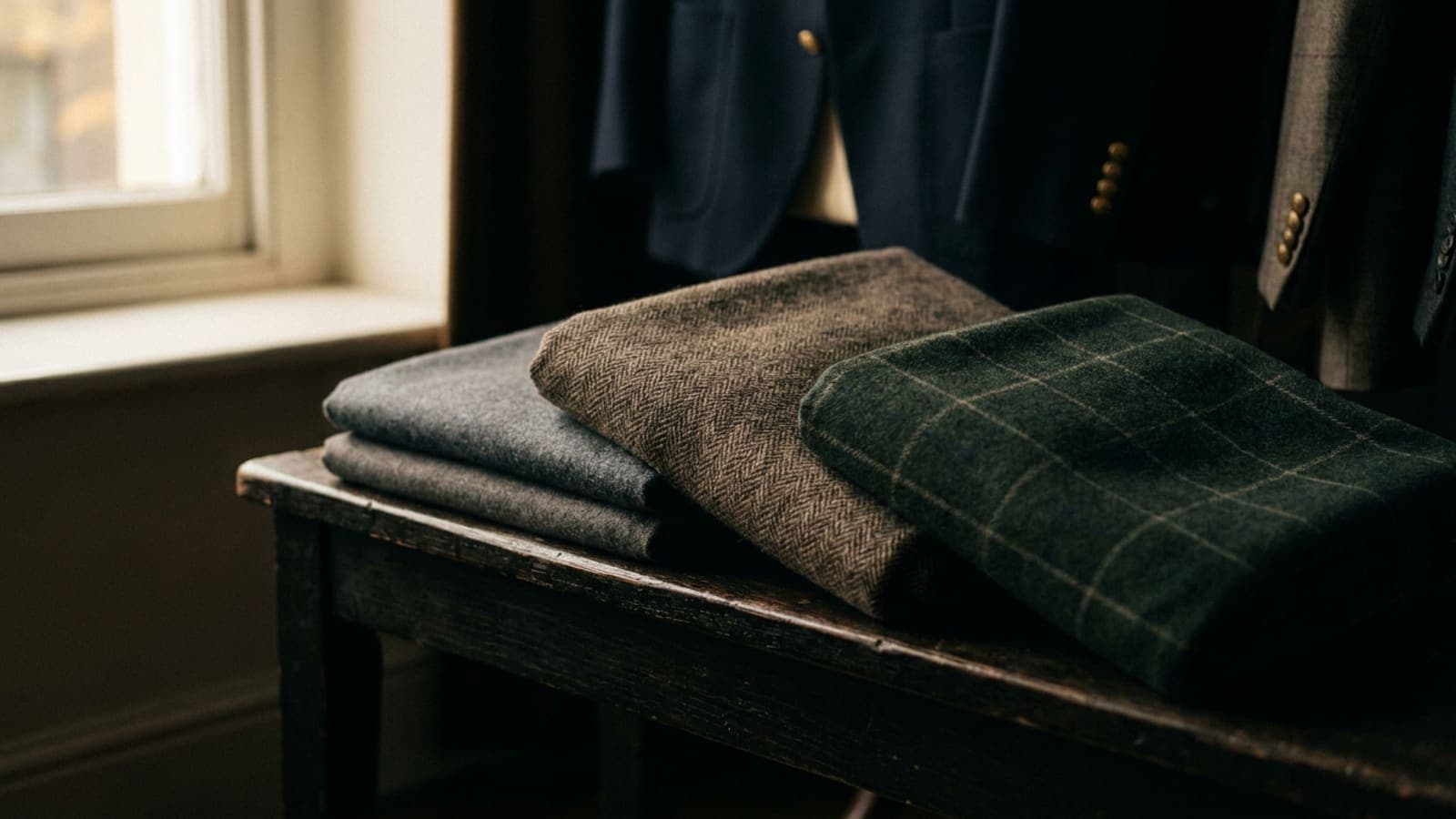
The defining pleasure of cold-weather cloth is surface. Summer fabrics are smooth and flat by necessity. Winter fabrics can have a nap, a hand, a visible weave — something to catch the low, soft light of the season, which is exactly the light that flatters pattern.
Where I would spend, in rough order of usefulness:
- Flannel — worsted or woollen, and the difference matters. Woollen flannel is softer, fuzzier, warmer and more forgiving; worsted flannel is crisper and holds a sharper line. A charcoal flannel suit is the most quietly authoritative thing a person can own
- Tweed, for a sport coat rather than a suit. Shetland, Donegal, a lambswool herringbone. Genuinely hard-wearing, and it improves as it ages
- Cavalry twill and covert cloth, for trousers that have to survive being worn constantly
- Corduroy, which is unfairly treated as a costume. A fine-wale corduroy trouser in tobacco or moss is enormously useful here
- Cashmere blends for outerwear, where the softness is worth the fragility because a coat takes less abrasion than a jacket
Pattern earns its place now. A windowpane check, a herringbone, a subtle glen plaid — these read properly in autumn light and look busy under a July sun. This is the season to own something with an opinion in it.
Layering that a jacket can survive
The most common winter mistake I see is a good jacket worn over a layer it was never cut to accommodate. A jacket fitted over a shirt in September and then worn over a chunky crewneck in January is not warmer, it is strained — the buttoning point pulls, the lapels bow outward, the shoulders sit wrong, and the whole silhouette collapses.
The fix is to decide in advance. If you intend to layer under a jacket, say so before the pattern is drafted and it will be cut with the room to do it. If you have a jacket you already love, keep what goes under it thin: a fine merino, a lightweight cashmere, a waistcoat. A waistcoat is the classical answer for a reason — it adds a full layer of warmth over the torso without adding bulk where the jacket has to close.
Warmth in tailoring comes from planning, not from wearing more. A jacket cut for one layer will be defeated by two.
The coat is the garment people underestimate
In the colder months your overcoat is the garment most people see most often. It is the first thing on when you arrive and the last thing off, it is what you are wearing on the street and in the lobby, and it is frequently the only thing anyone sees at all. It is also usually the least considered thing in the wardrobe.
The two requirements are that it be cut long enough to cover the jacket beneath it — a coat that ends above the jacket hem looks wrong in a way that is hard to unsee — and that it be cut generously enough through the chest and shoulder to go over tailoring without compressing it. Almost every off-the-rail coat fails the second test, and it is one of the more satisfying things to correct.
Why winter is the right time to commission
There is a practical argument for starting a bespoke commission in the colder months, and it has nothing to do with the cloth. It is that heavier fabrics are simply easier to fit well. Weight makes drape visible. A flaw in balance that a light summer cloth would disguise is obvious in flannel, which means it gets found and corrected at the basted fitting rather than living in the finished garment.
The process is the same as always: a forty-five minute commission appointment with a $75 bespoke deposit to talk through how you live, choose cloth and take measurements; then a scrap fitting in inexpensive fabric to prove the pattern, a basted fitting in white basting thread while everything can still be moved, and a forward fitting before delivery.
Come in and handle the winter cloths. They are the ones that make the case for themselves — nobody has ever needed to be talked into a good flannel.