People are often reluctant to start a first commission, and when I ask why, the answer is usually not price. It is that they do not know what they are agreeing to. So here is the whole sequence, in order, with nothing left out.
The commission appointment — forty-five minutes
It takes a $75 bespoke deposit and it is mostly conversation. Where do you actually go. What does the week look like. Do you drive or fly. What do you own that you reach for without thinking, and what do you own that you never touch.
Then cloth, which is the part you have to do with your hands rather than your eyes. Fabrics that photograph almost identically behave nothing alike once they are made up — a tightly woven lightweight worsted and an open-weave high-twist can look the same on the shelf and produce entirely different garments in a Raleigh August.
Measurements come last and take the least time. What takes the time is reading how you stand, which shoulder is lower, and whether the way you are standing in front of me is the way you will stand at the event.
The pattern
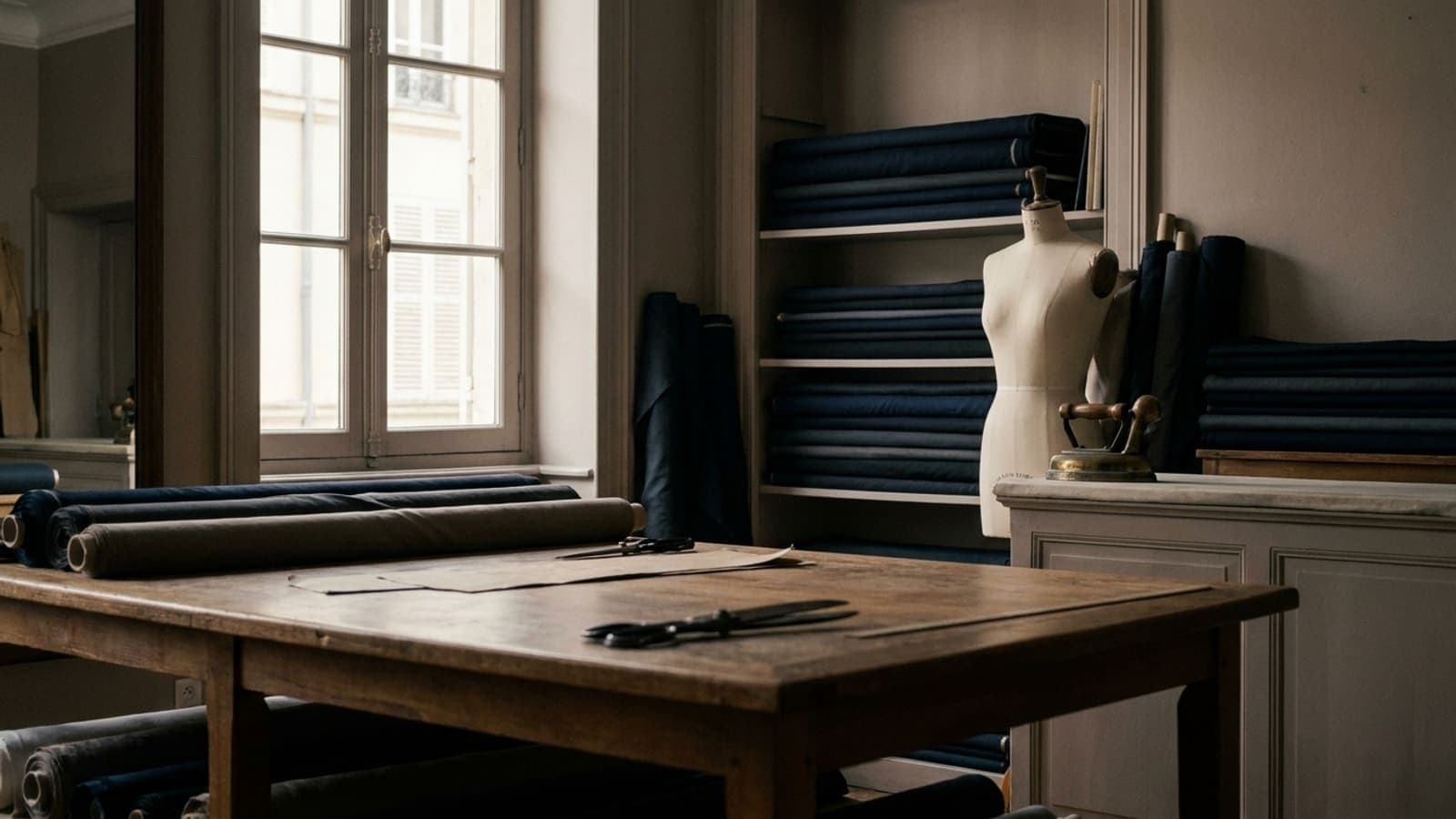
Nothing is cut yet. What happens next is at the pattern table, where a paper pattern is drafted for one body and no other. Everything downstream is determined here — this is the garment, in the sense that every subsequent decision is constrained by it.
The pattern is kept afterwards. It is a record of a specific person at a specific point in their life, and it is why a second commission is quicker and better than a first.
Fitting one — the scrap fitting
The pattern is made up in inexpensive fabric and you put it on. It looks like nothing. It is not meant to look like anything; it is a three-dimensional test of a two-dimensional idea.
Mistakes at this stage are expected and welcome, because they happen on material nobody paid for. Your cloth has still not been touched. This is the fitting that most houses skip and the one that most reliably prevents an expensive problem.
Fitting two — the basted fitting
Now in your actual cloth, loosely stitched together in white basting thread. Unlined, unpressed, sometimes with one sleeve. It looks worse than anything you would choose to wear, and that is precisely the value: nothing is committed, so balance, drape and shoulder can all still be moved.
This is the appointment that decides whether the garment will be good. It is worth not rushing, and worth standing still through the long silences while somebody looks at you properly.
Fitting three — the forward fitting
The last appointment before delivery. The jacket is essentially made; what remains are the refinements — sleeve length, trouser break, the small final corrections that separate a very good fit from a correct one. We are no longer solving problems here, and if we are, something went wrong earlier.
How long the whole thing takes
Typical turnaround on tailoring is one and a half to two weeks, and a full commission is longer because of the fittings between. Rush options exist for genuinely time-sensitive work — a wedding, travel — with an additional urgent fee agreed in advance.
The single most useful thing I can tell anyone working backwards from a date is to come in before you think you need to. Everything above has a rhythm, and the rhythm is far kinder when nobody is counting days.
And afterwards
A garment leaving the workroom is not the end of it. It is cut with inlay in the seams so it can follow you as you change, and we maintain what we make for as long as it is worn. For clients on the Everything Capsule Wardrobe that maintenance runs for the life of the garment.
What we need from you
Less than people expect, but the parts that matter are not optional. Turn up to the fittings — a commission stalls in exactly one place, which is between a garment being ready to fit and a diary finding an hour. Bring the right shoes to every one of them, because trouser length is measured against a real heel and a hem cannot be uncut.
And say when something feels wrong. The single most common cause of a garment that is nearly right is a client who was too polite at the basted fitting. If it pulls when you reach forward, or catches at the neck when you turn your head, that is information, and the basted fitting is where it is cheapest to act on.
The commonest questions
- Can I choose cloth before the first appointment? You can look, and it is a pleasant way to spend an evening, but decide in the room. Cloth photographs badly and behaves differently made up than it does on a roll
- What if I change my mind about the cloth after the scrap fitting? That is fine — the scrap fitting is deliberately in inexpensive fabric and yours has not been cut
- Can somebody come with me? Yes, and it is often useful. A second opinion at the basted fitting is worth having, provided it is somebody who will say what they think
- What if I lose weight before the wedding? Tell me at the start. A garment can be built with that in mind, and it is far easier to plan for than to correct at the forward fitting